
Geography: between the Adige and Vallagarina, crossroads of cultures
Rovereto is known as the “City of the Oak” for the ancient presence of an oak forest, a tree later depicted in its coat of arms.
The city occupies a geographically strategic position of exceptional importance in the Vallagarina, the last stretch between the mountains of the valley crossed by the Adige River. It lies at the heart of what is called the “Gateway to Trentino,” a linking ring between different territories and cultures, plains and mountains, Italian and Central European civilizations.
The Vallagarina, characterized by vast expanses of vineyards bathed by the Adige, was in the past an important commercial axis between Veneto and Trentino-Alto Adige. The river, with its 409 kilometers in length and a watershed of 12,100 km², is the largest watercourse in Trentino. Rovereto is strategically located about 25 km south of Trento and 70 km north of Verona, along the main route that runs through the Adige Valley.
The city is a true crossroads between valleys: to the east lie the plateaus of Folgaria and Lavarone, to the southeast Vallarsa and Mount Pasubio, while to the north rises the Mount Bondone range. Lake Garda is just 15 km to the west, making Rovereto easily accessible from various tourist and commercial routes. Its privileged position along the Verona–Trento–Bolzano axis made Rovereto an important communication hub, today served by the Brenner railway line and the A22 motorway.
Historical Notes: from Roman origins to the contemporary era
Early evidence and the Roman period
The earliest archaeological finds discovered by Paolo Orsi in Vallagarina date back to 2000 B.C. Later, Gallic coins from 800 B.C. were found, followed by many materials from the Roman period, up to 16 B.C. when Drusus, stepson of Augustus, conquered what is now Vallagarina and Alto Adige, granting agricultural farmsteads to Roman soldiers—many localities still bear their names (Licius → Liciana → Lizzana; Aulus → Avolano → Volano; Gallius → Galliano → Calliano, etc.).
With Augustus, Trentino thus became part of the Tenth Italian Region. With the decline of the Roman Empire came barbarian invasions: first the Huns of Attila, who destroyed almost all the settlements, then Theodoric in 490.
The Middle Ages and the rise of the Castelbarco family
In 568 the Lombards arrived, founding the Duchy of Trento, while Vallagarina was entrusted to Count Raligone of Lagaro. With the spread of Christianity (symbolized by the marriage of Autari and Theodolinda in the small Romanesque church south of Ala), a new community formed from Latins and Lombards, enjoying a long period of peace.
After the defeat of the Lombards by Charlemagne, the Franks founded the Trentine March, which passed to his son Lothair, while Alto Adige went to Germany under Louis. The continued belonging of Trentino to the Kingdom of Italy explains why, despite the constant German aristocratic rule, the Italian linguistic and cultural character of the region remained intact.
In the 1100s–1200s Rovereto grew in importance as a market town, while the enlightened Prince-Bishop Federico Vanga’s rule in Trento ensured peace and prosperity. In the 1300s the Counts of Castelbarco, successors of Iacopino da Lizzana in the fief, moved to Rovereto, fortified the castle, and promoted the economy and trade.
Venetian rule (1416–1509)
In 1416 Venice took possession of the town, and the first podestà, Basadonna, initiated the transition from feudal estate to municipality. In this period occurred the remarkable enterprise of moving the Venetian fleet from Verona to Ravazzone via the Adige, and then overland—pulled by oxen—to Torbole on Lake Garda, where they defeated the Visconti fleet of Milan.
In 1487 the Serenissima clashed with the army of Duke Sigismund: after initial victories, the Venetian general Sanseverino was defeated at Calliano, but Venice retained control of Vallagarina and Rovereto. Culturally, it was during Venetian dominion that Rovereto received the imprint that would later make it the driving center of Trentino’s cultural renaissance.
The Austrian period, the silk industry, and the intellectual revival
In 1509, with the League of Cambrai and the Venetian defeat at the Battle of Agnadello, Rovereto passed to the Austrian Empire. Emperor Maximilian I of Habsburg elevated the settlement to city status on November 3, 1510, confirming and expanding its privileges from the Venetian period. In 1564 the city was incorporated into Tyrol, losing part of its former autonomy.
This was the Renaissance era—while Bishop Bernardo Clesio and later Cristoforo Madruzzo governed in Trento—when Rovereto began to flourish. G. Savioli built the first silk-spinning mill; by the early 1700s, spinning and dyeing works employed a thousand people directly and four thousand in related industries, making Rovereto the European capital of silk.
In 1672 the Grammar School was founded thanks to a bequest by Ferdinando degli Orefici; in 1764 the Civic Library was established—the first in Tyrol. The municipality decreed compulsory education up to age 12; in 1783 the Civic Theatre was built by private initiative.
Alongside commercial and political growth came an 18th-century intellectual awakening, witnessed by figures such as C. Vannetti with the Academy of the Agiati (“a forge of literature and national unity”); Antonio Rosmini, who conceived a new alliance of faith and reason in response to Enlightenment thought; the Fontana brothers, university professors in Rome and Pisa; C. Martini, professor at the University of Vienna and Vice President of the Supreme Court; G. Borsieri, professor in Pavia and physician to the Governor of Lombardy; and C. Firmian, Governor of Lombardy under Maria Theresa, protector of writers and promoter of the region’s cultural rebirth after the Spanish rule.
Thus Rovereto became, for German visitors, the first tangible encounter with Italian civilization. Goethe wrote in his Italian Journey in 1816: “Here I am in Rovereto, the dividing point of languages: how glad I am that this beloved language is now becoming a living tongue, the language of daily use.”
The World Wars and the contemporary era
The First World War deeply marked Rovereto. On May 29–30, 1915, following Italy’s entry into the war, the population was evacuated and deported to Austria and Bohemia. The city, remaining in Austrian hands, suffered heavy bombardment by the Italian artillery throughout the conflict.
In 1921 the Italian War History Museum was inaugurated in the castle by a group of citizens to document the events of the First World War. Between 1933 and 1936 the Military Shrine of Casteldante was built, housing the remains of 20,279 Italian and Austro-Hungarian soldiers.
During the Second World War the castle served as an air-raid shelter for the population, with deep tunnels excavated to protect citizens from bombings.
Churches, Monuments, and Palaces: Architectural Heritage
Corso Rosmini and Piazza Rosmini
Corso Rosmini is one of the main streets of the city, built in the 19th century as a broad connecting axis from the railway station to the city center. About one kilometer long and twenty-two meters wide, it is lined with horse chestnut trees and prestigious buildings that preserve their original 19th-century layout.
At the end of the avenue opens Piazza Rosmini, inaugurated in 1852 and notable for the large circular fountain built in 1895 by the “Society for Beautification.” The fountain, with its water displays, symbolizes Rovereto’s wealth of water—an essential element for the city’s economic well-being. The square is dominated by the stately Palazzo Del Bene (later Conti d’Arco), a Renaissance building from the 15th century featuring a spacious loggia decorated in the early 20th century by architect Augusto Sezanne.
Church of San Marco
The Archpriest Church of San Marco, begun in 1458 and consecrated in 1462, is one of the city’s most important religious buildings. Built during the Venetian rule in honor of the patron saint of that Republic, the church stands out for its Baroque façade, updated in 1950 with an elliptical pediment bearing the statue of the Lion of St. Mark.
Inside, there is a large central nave with three chapels on the left side, decorated with frescoes by Luigi Cavenaghi and gilded stuccoes by Pietro Calori. Particularly noteworthy are the nine marble altars from the 18th century and the fresco above the presbytery depicting the consecration of the city of Rovereto to Mary Help of Christians in 1703.
The 16th-century organ in rococo style holds special historical significance: it was on this instrument that the young Wolfgang Amadeus Mozart gave his first Italian concert on December 26, 1769.
Palazzo Betta Grillo
Palazzo Betta Grillo is one of the most refined examples of 18th-century aristocratic residence in the city. Built in the first half of the 18th century by the Community of the Regola di Lizzana, it was acquired by the Betta family in 1728 and turned into an aristocratic home. In 1899, it came into the possession of the Grillo family.
The palace abounds with stuccoes, period tapestries, original furnishings, and artworks of considerable value. Of particular note are seven large canvases painted by Gasparantonio Baroni Cavalcabò (1682–1759) in collaboration with his cousin Giovanni, and four splendid wall paintings by Giovanni di Dio Galvagni (1763–1819).
The 19th-century garden, recently restored with funds from the National Recovery and Resilience Plan (PNRR), was reopened to the public in April 2024 as an “oasis of peace and beauty.” The English-style garden, with Italian influences, features winding paths and naturally shaped flowerbeds in the “picturesque” style of the era.
Palazzo Alberti-Poja
Palazzo Alberti Poja, begun in 1778 on Corso Angelo Bettini, is another prestigious example of 18th-century noble architecture. Architect Ambrogio Rosmini supervised its construction, while the interior decorations were carried out between the late 18th and early 19th centuries.
The building preserves a chapel from 1782 and, on the noble floor, several frescoes painted by Marco Marcola (Verona, 1740–1793) with the help of his brother Francesco. The centerpiece of the ceiling in the main hall is the painting depicting The Judgment of Paris. Recently restored, the palace is now used to enhance the collections of the Civic Museum through temporary exhibitions and permanent displays.
Palazzo Pretorio
Palazzo Pretorio, an elegant 15th-century structure, forms the heart of the city’s political life and is one of the most significant buildings in Rovereto’s historical heritage. Construction started in 1417 at the behest of the Venetian podestà Andrea Valier, who made it his residence and home to the municipal offices.
The palace underwent further expansions and transformations: in 1424 Francesco Basadonna ordered the first extension, while the most prominent architectural intervention took place in 1476 under podestà Pietro Venier. At this time, a loggia over the Leno stream was created and the façade was decorated with a checkerboard pattern attributed to Giovanni Pietro Bellini.
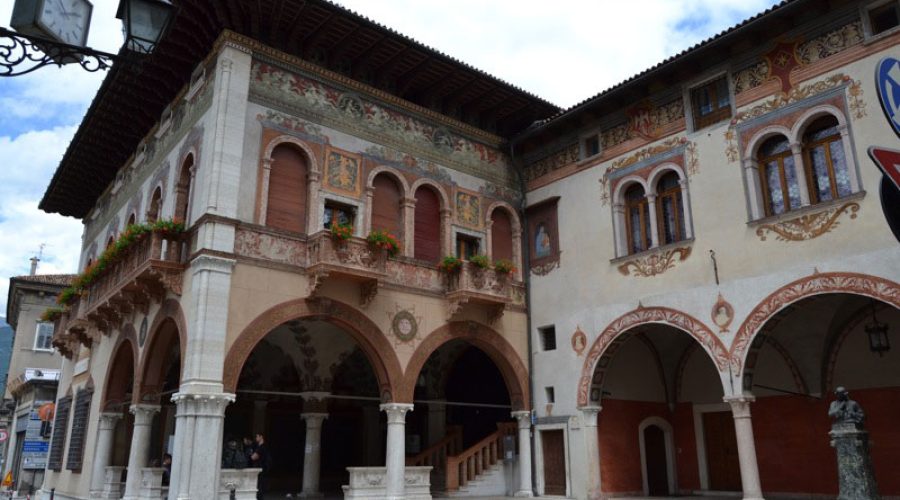
The façade facing Piazza del Podestà embodies two historical periods: the Venetian 15th century on the right, and the 18th-century style on the left. The arcade with three arches, frescoes above the ancient canal, wooden ceiling in the Council Chamber, and two frescoes in the Mayor’s Room recall the Venetian rule.
Of particular interest is the stone plaque with bronze linear measurements adopted in 1770: the Venetian pertica and the Viennese braccio with their corresponding local units. The massive renovation by Augusto Sezanne in the early 20th century produced the loggia toward the courtyard, frescoed with the coats of arms of the successive governments of Rovereto.
Civic Tower
The Civic Tower, 45 meters high, is one of Rovereto’s most recognizable symbols. Incorporated into the defensive walls of the Castelbarco family around 1300 to defend the city’s northern gate, the tower was built in several stages reflecting the evolution of medieval defensive techniques.
The first construction phase, before the late 12th century, saw a quadrangular plan with sides between 7.60 and 8 meters, an above-ground height of 22.7 meters, and wall thickness of about 2 meters, topped by squared battlements typical of “dropping” defense systems.
The first elevation, between the late 12th and early 13th centuries, raised the height to 30 meters, retained battlements, but added splayed loopholes on the west and east sides for better defense. In 1224 the presence of a bell, used to call citizens to assembly, is recorded for the first time.
The definitive completion came in the 14th century, when the tower reached its current height of 45 meters and gained its distinctive projecting structure. For centuries it summoned citizens and signaled dangers, becoming a key point of reference for the community.
Zandonai Theatre
The Riccardo Zandonai Municipal Theatre is the first theater in Trentino and one of the most significant examples of 18th-century theater architecture in the region. Built in 1782 to plans by architect Filippo Maccari, pupil of Carlo Galli da Bibbiena, the theater was directly inspired by the Philharmonic Theatre of Verona.
The initiative came from the cultural ferment of Rovereto’s 18th-century aristocracy and middle class, led by Count Francesco Alberti Poja and Knight Luigi Carpentari di Mittenberg. The theater was inaugurated on May 26, 1784, with Domenico Cimarosa’s comic opera “Giannina e Bernardone.”
The building witnessed the city’s turbulent history: during the First World War it suffered serious damage, being used as a stable, warehouse, and barracks. In 1920 it was purchased by the municipality and, after extensive restoration, reopened on April 30, 1924, with Riccardo Zandonai’s “Giulietta e Romeo,” to whom it was soon dedicated.
The theater features a horseshoe-shaped hall with three tiers of boxes and a gallery, copying the design of the Verona Philharmonic. In the 19th century it was expanded toward Corso Bettini, acquiring its current look. After twelve years of restoration ending in 2014, the theater reopened with its 1871 façade, grand ceiling above the stalls, four levels of wooden boxes, and restored original decorations.
Rovereto Castle
The Castle of Rovereto, one of the finest examples of late medieval Alpine fortification, dominates the city from the right bank of the Leno stream. The original construction dates to the 14th century under the Castelbarco, although some sources suggest the foundations may be earlier, possibly by Mainardo of Tyrol in the mid-13th century.
The most significant transformation came under Venetian rule (1416–1509), when the Republic radically altered the medieval plan, giving the castle its current pentagonal shape. Venetian architects Giacomo Coltrino and Bartolomeo d’Alviano designed the gun decks, sentry walkways, bastions with dozens of embrasures, a moat, and a 57-meter deep siege well.
The three towers—Marino, Malipiero, and Coltrino—are named for the principal Venetian patrons and builders. In 1492, to strengthen defenses, the circular tower was built on the eastern corner, about 25 meters high with a base diameter of 16 meters.
Since 1921 the castle has housed the Italian War History Museum, founded to document the events of the First World War. The Marino and Malipiero towers contain a vast collection of modern weaponry: armor, edged weapons and firearms, dueling and hunting arms from the 16th to the 18th century.
Rovereto thus presents itself as a layered city, where each historical era has left significant marks on its urban fabric. From Palazzo Pretorio, a testimony to Venetian rule, to the Civic Tower, symbol of the medieval Castelbarco power, from Zandonai Theatre, an expression of 18th-century aristocratic culture, to the Castle looming above with its imposing presence: each building tells a different chapter of the city’s history, making Rovereto a true “crossroads of cultures” at the heart of Vallagarina.