
Rovereto, an elegant town in Vallagarina, is a true treasure chest of cultural and artistic heritage in the heart of Trentino. Located just 25 kilometers from Trento and 15 from Lake Garda, this refined little city offers an exceptionally rich cultural landscape, where millennia of history, contemporary art, and science merge into a unique experience for visitors passionate about culture.
MART: Temple of Modern and Contemporary Art
The Museo di Arte Moderna e Contemporanea di Trento e Rovereto (MART) is one of Italy’s cultural jewels. Its iconic glass and steel dome, designed by star architect Mario Botta and engineer Giulio Andreolli, has become Rovereto’s signature landmark. Opened in 2002, the museum houses an invaluable collection of about 20,000 works that retrace more than 150 years of art history, from the major movements of the 20th century—Futurism, Novecento, Metaphysics, Abstractionism, Arte Povera, Conceptual Art—to the latest expressions of contemporary creativity.
Casa d’Arte Futurista Depero, the Only Museum Founded by a Futurist
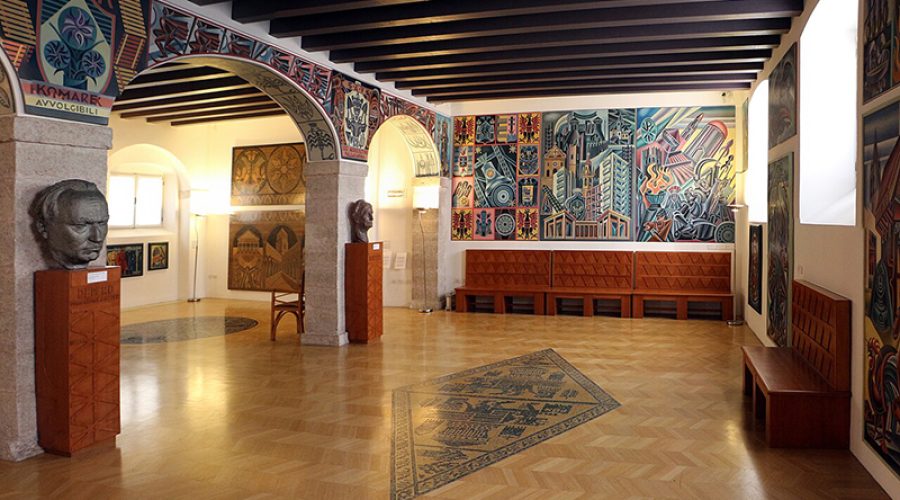
Just a ten-minute walk from MART, in the picturesque medieval old town, stands the Casa d’Arte Futurista Depero, a unicum in the global museum landscape. Founded in 1957 by the artist Fortunato Depero himself, it is the only museum in the world conceived by a Futurist. Restored by architect Renato Rizzi and reopened in 2009 for the centenary of Futurism, the Casa displays some 3,000 works, including paintings, graphics, furniture, wooden inlays, tapestries, and toys—testimonies to the creative genius of this pioneer of contemporary design.
Fondazione Museo Civico: Science, Archaeology, and Astronomy
The Fondazione Museo Civico di Rovereto, one of Italy’s oldest science museums founded in 1851, is spread over two main sites. The Museum of Science and Archaeology at Palazzo Parolari offers an engaging journey through archaeology, zoology, botany, astronomy, earth sciences, and robotics. Its valuable collections include minerals, fossils, archaeological finds, and the splendid Paolo Orsi collection of Italic vases.
The City Museum at Palazzo Sichart instead traces Rovereto’s history from prehistoric times to the modern era, through an interactive, multisensory journey that reveals the city’s urban, social, and cultural evolution.
The scientific offer also includes the Monte Zugna Astronomical Observatory, perched at 1,620 meters in an area free of light pollution, and the Planetarium, which allows visitors to explore the universe through cutting-edge technology.
MITAG: Memory of the Great War
The Italian War History Museum (MITAG), housed in the imposing Rovereto Castle—Trentino’s only Venetian fortress—safeguards one of Italy’s richest collections dedicated to the history of conflicts from the Risorgimento to World War II. Founded in 1921, the museum documents, through weapons, uniforms, photographs, documents, and everyday objects, the experiences of both soldiers and civilians, inviting visitors to reflect on the tragedies of war.
Accademia Roveretana degli Agiati: Centuries of Cultural Tradition
The Accademia Roveretana degli Agiati, founded in 1750 by young intellectuals trained under Girolamo Tartarotti, is among Trentino’s oldest cultural institutions. Officially recognized by Empress Maria Theresa in 1753, the Academy has fostered cultural exchange between Italy and the German-speaking world for more than two and a half centuries, publishing its academic “Proceedings” without interruption since 1883.
Bell of the Fallen and Ossuary of Castel Dante: Symbols of Peace
The Bell of the Fallen Foundation manages Rovereto’s most meaningful war memorial: the Maria Dolens Bell. Cast in 1924 from the bronze of cannons donated by nations involved in World War I, this 22-ton bell—the largest in the world still rung by peal—tolls every evening from the Miravalle Hill to honor all war victims and call for universal peace.
Nearby stands the Ossuary of Castel Dante, an imposing shrine built between 1933 and 1937 on the ruins of Lizzana Castle. It holds the remains of over 20,000 soldiers—Italians, Austrians, Czechoslovakians, and Hungarians—along with the tombs of Rovereto’s patriotic martyrs Damiano Chiesa and Fabio Filzi.
Great War Sites: Open-Air History
The Rovereto area preserves extraordinary vestiges of World War I. The Monte Nagià Grom trenches form a veritable fortified citadel, with three kilometers of trenches, passageways, and concrete emplacements once garrisoned by hundreds of Austro-Hungarian soldiers between 1915 and 1918. The Monte Zugna Trincerone was instead a crucial Italian defensive position, where opposing trenches stood only 150 meters apart, offering a striking testimony to the static warfare of the period.
Dinosaur Footprints at Lavini di Marco: Paleontology at its Finest
The Lavini di Marco site is one of Europe’s most significant paleontological areas. Along a steep 200-meter rockslide at the foot of Monte Zugna lie over a thousand fossilized dinosaur footprints dating back 200 million years. This extraordinary Jurassic site records the passage of theropod carnivores, early sauropods, and primitive herbivorous ornithischians, offering a unique window into the region’s prehistoric life.
An Invaluable Cultural Heritage
Rovereto thus presents itself as a cultural destination of the highest order, able to satisfy every curiosity: from contemporary art to ancient history, from science to astronomy, from war memory to paleontology. This wealth of museums, combined with the architectural beauty of the historic center and its strategic location between Trento and Lake Garda, makes the “City of the Oak” an unmissable destination for lovers of art, culture, and history wishing to discover one of Trentino’s most fascinating corners.